Why declining website traffic doesn’t necessarily mean SEO is failing.
I’ve been working in search marketing for nearly 20 years, and I’ve never seen our industry change as rapidly as it has over the past two.
Obviously, artificial intelligence has a lot to do with that.
Google is fundamentally changing its search experience. ChatGPT and other AI platforms are giving people entirely new ways to find information. And behind the scenes, these tech companies are battling for something incredibly valuable: our attention.
But there’s another transformation happening that I think deserves more attention.
The way we measure search marketing success is becoming increasingly disconnected from the actual value it creates.
And for business owners investing in SEO, this can be incredibly confusing
You might see declining organic traffic, fewer clicks, and inconsistent ranking reports and naturally conclude that your search marketing isn’t working.
But what if the problem isn’t necessarily your marketing?
What if the way people search has changed so dramatically that the metrics we’ve relied on for years simply don’t tell the whole story anymore?
I believe that’s exactly what’s happening.
The Search Experience Has Fundamentally Changed
Think about how Google worked just a few years ago.
You’d type a question into the search bar, receive a list of websites, and click one of those blue links to find your answer.
For businesses, this created a fairly predictable relationship between visibility and website traffic.
Links-Rankings-Impressions-Traffic-Conversion
If your website ranked on the first page of google, you received more impressions. Those impressions created opportunities for clicks, especially in the top 3-5 positions. And those clicks brought potential customers to your website. And sometimes, a lot of irrelevant traffic.
Now, increasingly, Google answers the question before you ever need to click anything.
AI Overviews pull information from multiple websites and present an AI response directly within the search results.
And Google’s AI Mode takes things even further, essentially creating a conversational, AI-powered search experience.
You can ask follow-up questions, explore complicated subjects, and receive increasingly detailed answers without visiting the websites providing much of that information. The sourced websites are often cited with a link to them, but the click-through rate on these links are lower than what it used to be when a website ranked in the top 3-5 positions.
From the user’s perspective, it’s actually pretty remarkable…But for business owners and the marketers responsible for generating website traffic, it changes everything.
The Rise of Zero-Click Search
Rand Fishkin recently published research through SparkToro examining how frequently Google searches result in clicks.
The findings are significant.
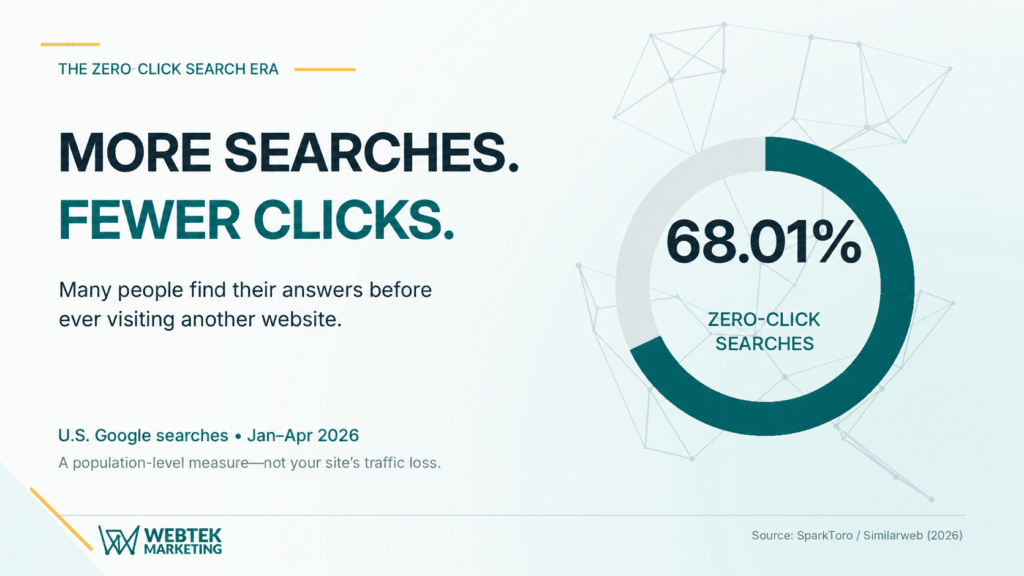
According to research conducted with Similarweb, 68.01% of U.S. Google searches ended without a click during the first four months of 2026.
That’s up from approximately 60% in 2024. And the no-click experience continues to rise, meaning that traffic from Search will continue to erode.
But, that doesn’t mean people are not still searching, and in fact they are possibly searching more due to better search tools and more refined sear experiences. It’s just that the path of the searcher is being measured and attributed.
Source: SparkToro — In 2026, Less Than One Third of Google Searches Still Send a Click. SparkToro
Think about that.
More than two-thirds of Google searches now end without someone clicking through to another destination.
And that’s just Google.
We’re not even accounting for all the searches now happening through ChatGPT, Gemini, Perplexity, and other AI platforms.
Plus
A separate study from Pew Research Center found that people clicked traditional search results in just 8% of visits when an AI Overview appeared, compared with 15% when one wasn’t present. Pew Research Center
Obviously, these numbers don’t mean every website should expect an equivalent percentage decline in traffic. Different industries, search queries, and customer behaviors produce different results.
But the direction is unmistakable.
A growing percentage of search activity simply isn’t producing the website visits it once did.
And that creates a major problem when website traffic is still one of our primary measures of SEO success.
The Old SEO Formula Is Breaking Down
For much of my career, SEO followed a relatively predictable progression.
Once a website’s technical foundation and on-page optimization were in good shape, we could focus on developing content, earning authoritative links, and improving rankings.
The general progression looked something like this:
Rankings → Impressions → Clicks → Website Traffic → Conversions
Of course, it was never a perfect science.
But it was measurable enough that we could reasonably demonstrate how improvements in rankings contributed to business growth.
Today, that relationship is becoming considerably less linear.
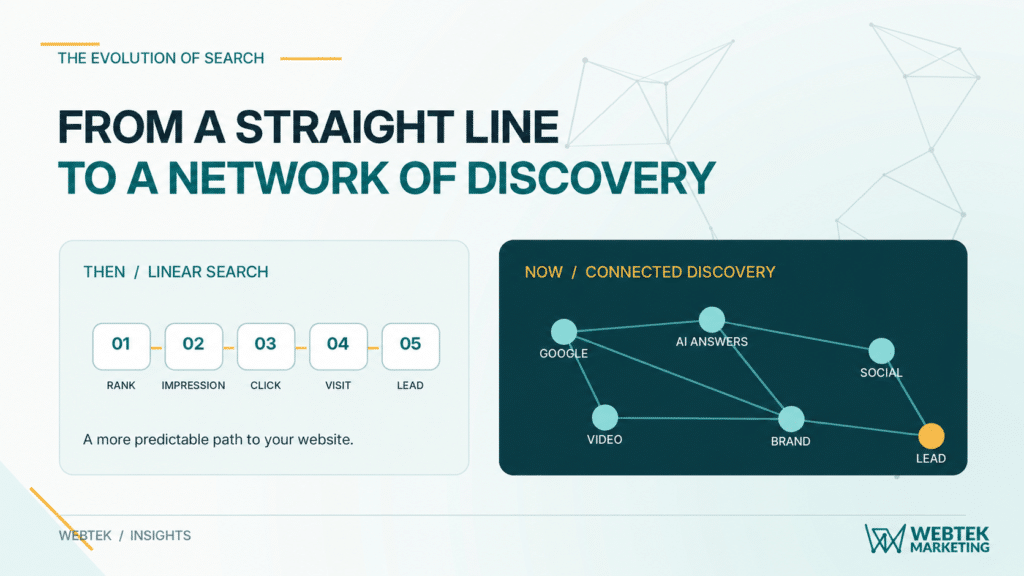
A company might maintain strong rankings while receiving fewer clicks.
Its content might be cited in an AI-generated response without generating a website visit.
Or a potential customer might discover the company through ChatGPT and return days later through a branded Google search.
The business may have benefited from its search marketing investment throughout that journey.
But traditional analytics might capture only the final interaction.
This brings me to something I’ve been thinking about quite a bit lately.
Are We Returning to the Old Days of Advertising?
In some ways, I think search marketing is beginning to look more like traditional advertising.
Before the internet gave us sophisticated analytics, companies spent enormous amounts of money on television, radio, magazines, and billboards.
And measuring the results wasn’t nearly as straightforward.
Imagine Tostitos running a commercial during the Super Bowl.
How would they determine whether it worked?
They might examine changes in sales, consumer awareness, retail distribution, or market share.
But they couldn’t necessarily connect every individual bag of chips sold to someone watching that particular commercial.
Or imagine a Jiffy Lube franchise running radio advertisements.
They could measure increases in customers visiting their locations, but they couldn’t always determine precisely which customers came because of the radio campaign.
The advertising could absolutely be working.
The attribution just wasn’t perfectly linear.
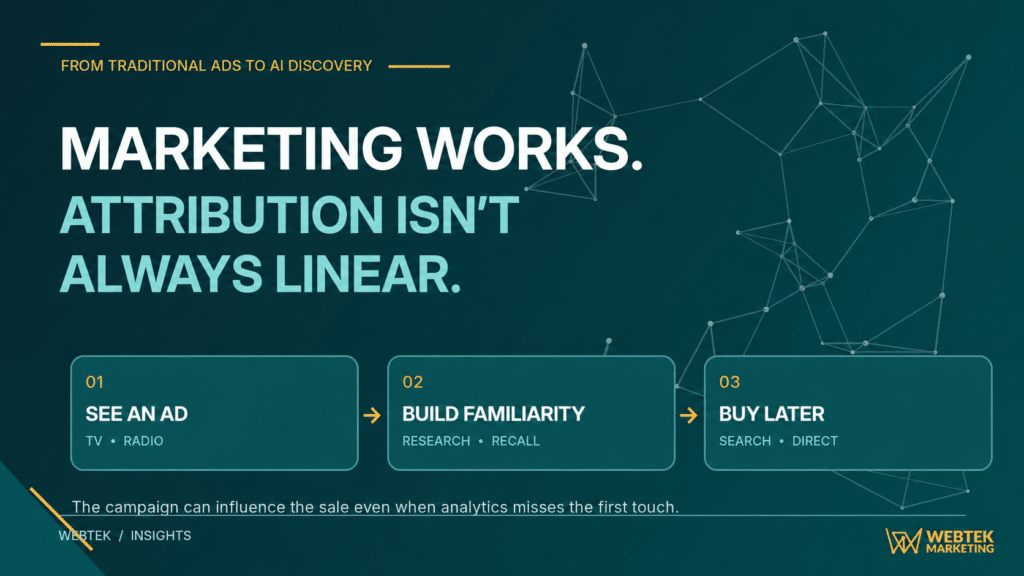
Then digital marketing came along and gave us something remarkable.
We could measure clicks, conversions, cost per acquisition, and eventually return on advertising spend.
We became accustomed to a level of reporting precision that traditional advertisers could only dream about.
And for a while, especially during the earlier years of SEO and paid search, we had a relatively clear picture of how our marketing efforts influenced customer acquisition.
But AI is changing that.
Someone might encounter your company several times through AI-generated recommendations without visiting your website.
They might become familiar with your brand, develop confidence in your expertise, and eventually decide you’re the business they want to contact.
When they finally visit your website, perhaps they type your company name directly into their browser.
Your analytics might attribute that customer to Direct traffic.
But did Direct traffic really create that customer?
Not necessarily.
The customer journey is becoming much more complex than the attribution models we’ve relied on to explain it.
And I think business owners need to understand that distinction.
Search Isn’t Going Anywhere
Here’s the part that I think gets lost in many of these conversations.
People aren’t going to stop searching.
Human beings are naturally curious.
We have questions, problems, fears, interests, and needs.
We want to learn things. We want to compare options. We want recommendations. We want to find products and services that solve our problems.
None of that is disappearing.
If anything, AI is making it easier to explore those questions in greater depth.
Someone who previously typed a few words into Google can now have an entire conversation about a complicated purchasing decision.
They can ask follow-up questions, consider alternatives, and refine their understanding before making a decision.
I think that’s an incredible evolution of the search experience.
But it also means that businesses need to think differently about how they’re discovered.
The goal can no longer be exclusively to rank for a keyword and generate a click.
The goal needs to be ensuring that your business is part of the conversation wherever your potential customers are searching.
That might happen through Google.
It might happen through ChatGPT.
It could happen on YouTube, Reddit, or another platform entirely.
And in many cases, the customer may interact with several of these platforms before contacting your business.
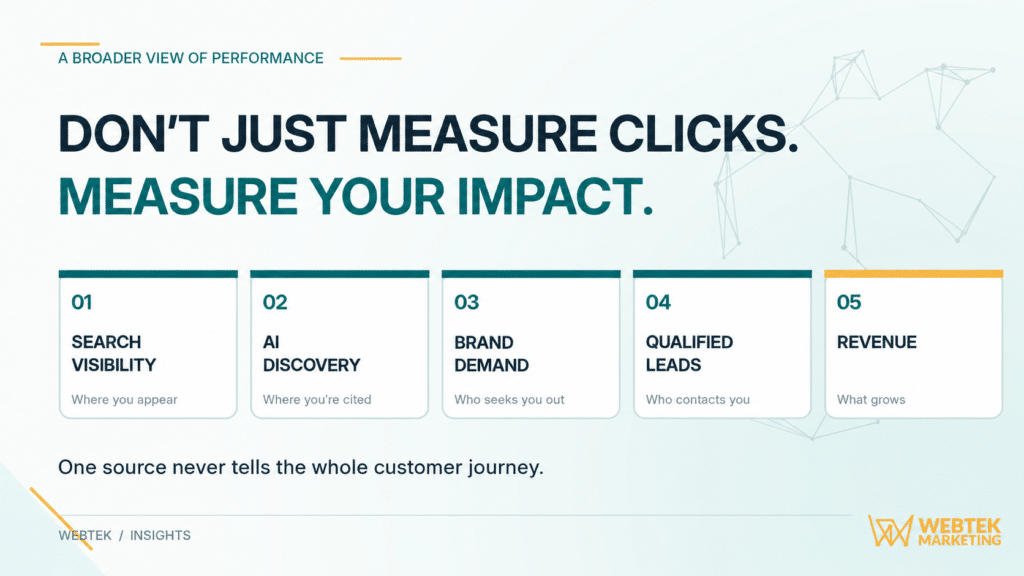
We Need to Change What We Measure
None of this means rankings, impressions, organic traffic, or conversions are suddenly irrelevant.
They’re still incredibly important.
But they no longer tell the entire story.
https://webtekmarketing.com/search-isnt-dyin…-of-how-it-works/
We need to look more holistically at how people are discovering businesses and making purchasing decisions.
Are we appearing in relevant search results?
Are AI platforms citing our content or recommending our company?
Are more people searching for our brand by name?
Are we generating qualified leads?
Are customers increasingly familiar with our company before they contact us?
And ultimately, is the business growing?
These are the kinds of questions that need to become central to modern search marketing.
Because a decline in organic traffic doesn’t automatically mean a decline in search visibility.
And an increase in search visibility doesn’t automatically mean an increase in business value.
We need to examine both.
For nearly two decades, I’ve watched search marketing evolve through countless Google updates, new technologies, and shifting customer behaviors.
This feels different.
We’re not simply adjusting to another algorithm update.
We’re watching the fundamental relationship between search, discovery, website traffic, and attribution change.
And I believe the businesses that understand this shift will be much better positioned for what’s coming next.
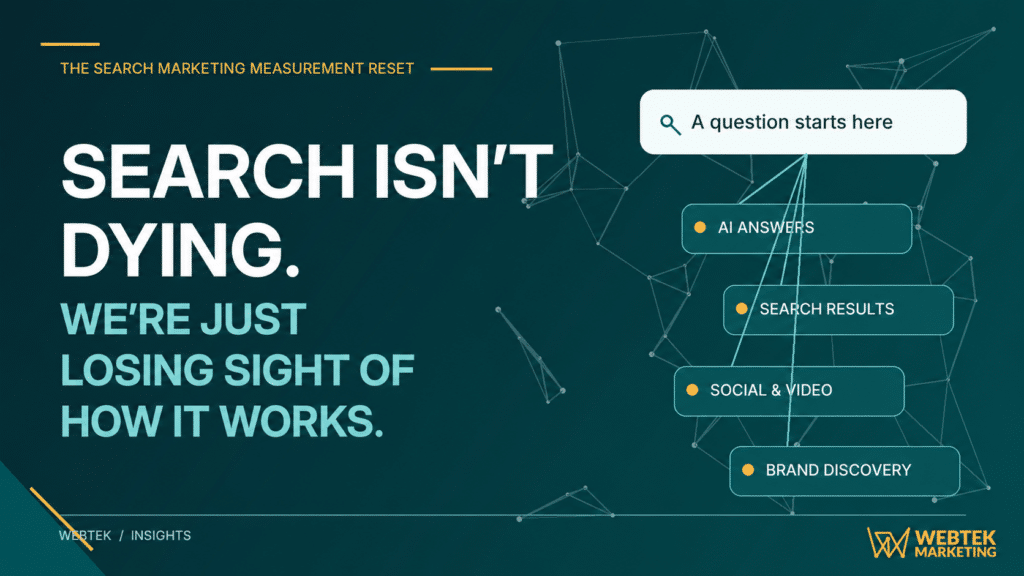
Search isn’t dying.
The old way of measuring it is becoming incomplete.
And it’s time our expectations caught up.
DOWNLOAD THIS ARTICLE AS A VISUAL INFOGRAPHIC